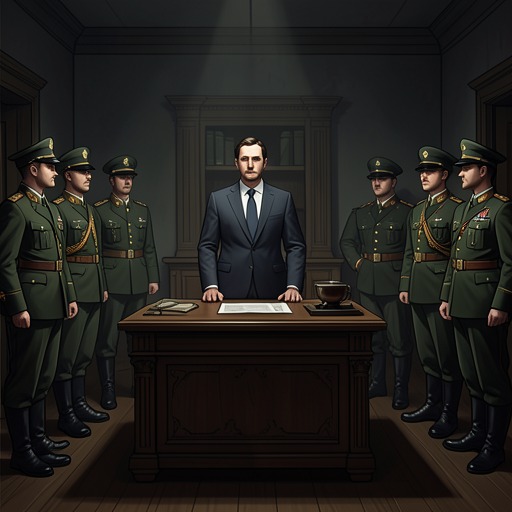
Dreyfus’s deportation to Devil’s Island
An Officer and a SpyAlfred Dreyfus’s deportation to Devil’s Island extended his military conviction into a life of enforced isolation. The decision was not simply to remove him from Paris: the French authorities selected a remote island, restricted his farewell with Lucie Dreyfus, and monitored the letters through which the couple tried to remain in contact. Georges Picquart’s account follows the transfer from public punishment to private separation, showing how distance and administrative control made the sentence endure beyond the courtroom.
From public sentence to remote confinement
The deportation followed the degradation ceremony at the École Militaire, where Dreyfus was brought before the assembled troops and the sentence was made public. An escort led him into the parade ground; after the formal pronouncement, he was stripped of his military status and required to march around the ground before the watching detachments. The ceremony lasted only minutes, but it presented the conviction as a public lesson about the treatment of a supposed traitor. For Dreyfus, that spectacle was the prelude to a punishment designed to remove him from public view altogether.
The rationale for the destination was explicitly isolation. Auguste Mercier wanted Dreyfus placed somewhere he could neither communicate with others nor receive messages from them. When Mercier considered the globe in his office, he rejected Cayenne in favor of Devil’s Island, off the coast of South America. Its position, the surrounding sea, and the difficulty of landing a boat made it more secure for the purpose. The island had been closed after serving as a penal settlement, but Mercier said it would be reopened for Dreyfus. A place already associated with confinement was thus prepared anew for a single prisoner.
Transfer and a restricted farewell
Twelve days after the degradation, Dreyfus was taken from his Paris prison in the middle of the night and put aboard a convict wagon at the Gare d’Orléans. The rail journey to the Atlantic coast lasted ten hours and passed through snowbound countryside. At La Rochelle, a hostile crowd waited by the train, shouting threats and insults. His guards delayed moving him until nightfall, when they judged the transfer could proceed. The route from Paris to the coast made the change in his status concrete: he was no longer only a prisoner under sentence, but a deportee being carried away from the people and places to which he belonged.
Lucie Dreyfus asked the minister for permission to visit her husband on Île de Ré before his departure. The request was granted for 13 February under strict conditions. The couple were to remain at opposite ends of a room, with guards and the prison governor between them; they could not discuss the trial or touch. Lucie offered to have her hands tied if that would allow her to approach her husband, but her request was refused. The arrangement permitted a farewell while carefully preventing it from becoming an ordinary meeting between spouses.
Their letters record the emotional importance of the visit without changing the restrictions imposed on it. Dreyfus wrote of the joy of the few moments together and of what he had been unable to express; Lucie described the shock of seeing him again. He also praised her devotion. These exchanges were part of a brief interval of contact before he boarded the warship Saint-Nazaire for the Atlantic passage. Separation was not a single event at the island’s shore: it began with a farewell in which even physical proximity had been regulated.
The passage and life on Devil’s Island
The voyage lasted fifteen days. Dreyfus was held in an unheated cell on an upper deck, exposed to the weather during winter storms, while armed warders watched him and did not speak to him. For much of the journey he did not know his destination; Cayenne was his guess. When the ship anchored, he saw Royal Island, St Joseph’s Island, and Devil’s Island. He learned that the smallest of the three was intended for him alone. Before he could move into his quarters there, he spent four days confined aboard the ship in tropical heat. He was then held on Royal Island for a month while his quarters on Devil’s Island were prepared.
After thirty days of close confinement, Dreyfus was transferred to the island. By day he could walk only within a small area and was followed by warders carrying rifles. At six in the evening he was locked in a hut measuring four metres square, closed by an iron grille; guards took turns watching outside throughout the night. His provisions were limited: half a loaf of bread each day, meat three times a week, and tinned bacon on other days, with water to drink. He had to collect wood, light his fire, cook, wash his clothes, and try to dry them in the humid climate. The routines required to sustain himself were his own responsibility, while his movement and contact with other people remained controlled by his guards.
In letters, Dreyfus described sleeplessness, vermin, and the repeated presence of the guard outside his hut. He also described the restricted ground available to him: barren soil, exposed basaltic rock, a few banana trees and cocoa palms, and the surrounding ocean. His concern for Lucie and their children recurs beside these practical descriptions. He wondered whether his letters reached home and described the isolation as so complete that it seemed like being buried alive. His account makes the punishment legible not only as a sentence of distance, but as the repeated experience of days without conversation, movement beyond a narrow boundary, or reliable news from his family.
Letters, surveillance, and the long aftermath
The authorities extended the isolation into the correspondence system. Lucie could not mention the case or related events in her letters, and she had to deposit them at the French Ministry of the Colonies by the twenty-fifth of each month. Officials in that ministry and the French War Ministry copied and read the letters. Copies were also examined by Étienne Bazeries, chief of the cipher bureau in the French Ministry of Foreign Affairs, to check for possible coded messages; Dreyfus’s letters to Lucie received the same scrutiny. The first batch of her letters reached Cayenne at the end of March but was returned to Paris for another check. Dreyfus received no word from home until 12 June, after four months of silence.
The preserved letters therefore show two forms of separation working together. The island kept Dreyfus physically apart from his family, while censorship made even the permitted channel of communication slow, conditional, and uncertain. The files through which Picquart reconstructs the episode preserve private messages but also expose the administrative machinery that delayed and inspected them. Dreyfus’s confinement was not a temporary pause before a prompt return: it shaped years of separation, and its consequences were eventually reversed only after the case was reviewed. In 1906 the Supreme Court of Appeal overturned the Rennes verdict and exonerated him; the following day, the Chamber of Deputies voted to restore him to the army as a major and award him the cross of the Legion of Honour. That later restoration stands against the original sentence’s attempt to make his removal permanent.